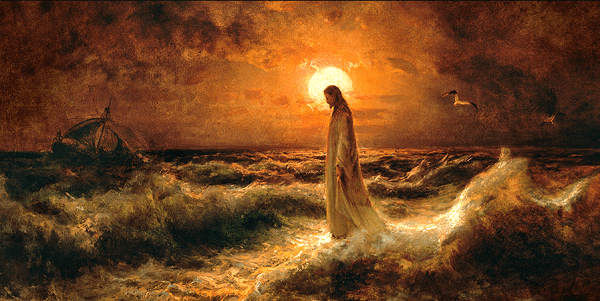
The Apostles’ Creed concludes its narrative of Christ’s mission with three pivotal events: “The third day he rose again from the dead. He ascended to heaven and is seated at the right hand of God the Father almighty. From there he will come to judge the living and the dead.” To develop our understanding of these articles, we will examine several biblical passages as we move through each movement of the Creed.
The Resurrection (1 Cor 15:1-58)
We begin with the event that redefines the human condition. The resurrection is the necessary condition for the Gospel. Paul writes this to the church in Corinth, a Greek city steeped in philosophies that mocked the idea of a physical resurrection. In response, Paul does not mince words: if Christ remained in the grave, the apostolic witness is a lie and Christianity is a futile exercise (vv. 14–17). Paul interprets this event through the lens of history. Think of the first man, Adam, as a corrupted root. Every branch that grows from him carries the disease of death. Christ, however, is a completely new seed. As the “last Adam,” He roots a new family tree in the soil of resurrection life (vv. 21–22, 45). Furthermore, Christ is the “first fruits.” In the Old Testament, this was the first portion of the harvest that served as a guarantee for the rest of the crop. His resurrection serves as the legal guarantee that the power of death is broken for all who are in Him (vv. 20–23).
This event changes the status of our daily labor. Paul does not suggest that resurection life is merely a distant hope. Rather, it is a present reality that defines our work. If the grave were the end, then our labors would be paid out in a currency that is about to collapse. But because the mortal is destined for immortality, our efforts are backed by an eternal ‘gold standard.’ Because we are united to the Risen One, our work is a permanent investment that survives the barrier of death. As Paul concludes in verse 58, this is why we must remain “steadfast” and “immovable,” because the resurrection proves that our labor in the Lord is never in vain. We have established this as the foundation: because Christ was raised, the believer’s life is now oriented toward a life-giving reality rather than a futile path toward death.
(1) How might knowing that your work is an “eternal investment” change the way you approach your daily tasks?
(2) Where in your life do you feel like you are just ‘grinding’ in vain?
The Ascension (Acts 10:34-48; Ephesians 1:15-23)
Building upon the foundation of the resurrection, let us examine the current state in which the believer lives. The Creed confesses that Christ ascended and is seated at the right hand of the Father. This “session” (the occupation of the Royal throne) fulfills Psalm 110, which celebrates the enthronement of Israel’s king. When the Psalmist writes, “Yahweh says to my Lord: ‘Sit at My right hand Until I put Your enemies as a footstool,’” he describes a king authorized by God to crush opposition. In the New Testament, the Apostles identify Jesus as this true King. Paul defines this in Ephesians 1:20–22 as an exaltation “far above all rule and authority and power and dominion,” establishing Christ as the head of all things. Peter confirms this in Acts 10:36, cutting through the exclusivity of the old covenant to declare to Cornelius’s household that Christ is simply “Lord of all.”
As we previously learned, this Lordship is an active, ongoing reign. We can compare this to the gap between D-Day and V-Day: the decisive battle has been won at the resurrection, and the King has taken the throne, but we are currently living through the “consolidation phase,” the interval between the decisive victory and the final peace treaty. We see this happening in Acts 10. By pouring out the Holy Spirit on the Gentile household of Cornelius, Peter demonstrates how the Risen King is disarming cultural hostilities and expanding His territory (Acts 10:44–48). We live under the mandate of a God who is actively disarming the remaining rebel forces, preparing for the final moment described by Paul in 1 Corinthians 15:24, when He will hand the completed, unified kingdom over to the Father.
(1) What is a specific area of your life where you struggle to surrender to Christ’s authority, and what makes it difficult for you to let go of control?
(2) How does the “D-Day to V-Day” metaphor (the idea that the victory is won, but we are in the ‘mop-up’ phase) help you make sense of the brokenness and conflict we still see in the world today?
The Judgement (Hebrews 9:11-28)
We arrive at the culmination of Christian hope, where the resurrection and ascension resolve in the return of Christ. The Creed concludes with the return of Christ to judge the living and the dead. This is the arrival of the final, restorative justice provided by Christ’s priestly work. To understand this, we have to look at the Old Testament. In the Old Tabernacle, the high priest performed a yearly ritual with animal blood to cover the people’s sins. Writing to Jewish Christians tempted to return to that Levitical system, the author of Hebrews explains that Christ did something infinitely better. He entered the “greater and more perfect tabernacle” (the New Tabernacle) and offered His own blood once for all, securing our “eternal redemption” and cleansing our conscience (vv. 11–14).
His return does not repeat the cross; that work was completed at the “consummation of the ages” (v. 26). It is the finalization of the covenant promise. As Hebrews 9:28 declares, He will appear a second time “for salvation” to those who are eagerly awaiting Him. Imagine standing in a courtroom for sentencing, only to realize the presiding Judge is the same Advocate who already paid your fine in full. Because the Judge is the very Jesus who satisfied the requirements of the Law through His own life and death, His return is not a cause for dread, but vindication.
(1) When you first think about Judgement Day, is your instinct to feel dread or hope? How does the image of your “Defense Attorney” serving as your Judge shift that perspective?
(2) Hebrews states that Christ will return for those who are “eagerly awaiting Him.” What does it look like to practically live out that expectation in your daily routine?